Generalized Spherical Harmonics
The generalized spherical harmonics model expands the ODF as a sum of harmonic functions in \(\mathrm{SO}(3)\) symmetrized by the crystal point group. They are convewnient because they split the ODF in different resolutions parametrized by the spherical harmonics order \(ell\). The model can be initialized from:
A maximum spherical harmoncis order \(\ell_{\mathrm{max}}\)
A list of symmetrized sperical surface harmonics correspinding to the crystal point group.
The Symmetrized harmics can be generated by functions from the odftt.spharm.symmetrized_harmonics_coefficients module.
While the GSHs are typically not the best choice for texture tomography reconstructions, they are used to perform some other computations efficiently. odftt uses a version of the GSHs that are completely real from definition following Schaeben and van den Boogart 2003.
If we treat the property of the Wigner matrixes to be able to rotate real-spherical-harmonics-coefficients as a definition, the phase convention of the Wigner matrices is set by the choice of phase constants and normalization for the surface harmonics. We have chosen the same as are used in mumott to ensure interoperability.
Full GSH coefficients are represented as lists of square matrixes while symmetrized coefficients should be interpreted in terms of a odftt.texture.odfs.Harmonics object which uses a single 1D vector where each element is the coefficient of one symmetrized mode. The property odf.mode_coefficients is a list of the full RBF coefficients of each symmetrized mode. odf.make_GSH_coeffs provides a utility to transform symmetrized mode coefficient vectors into full GSH basis.
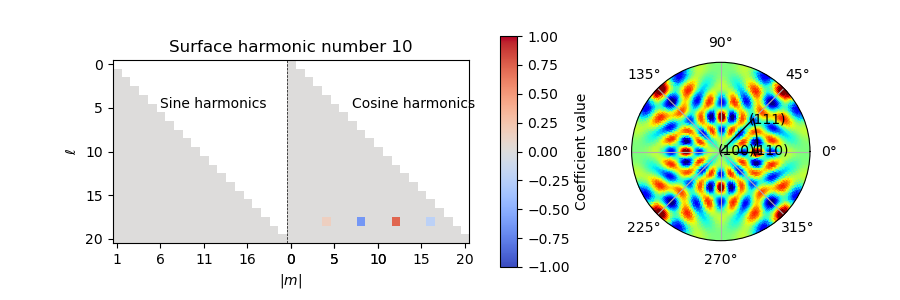
An example of a cubic-symmetric surface harmonic used in the definition of symmetrized GSHs.
Jupyter notebooks: