Radial Basis Functions
The radial basis funcitons model expands the ODF as a sum of localized radially symmetric basis function in orientation space symmetrized over point-group symmetries. It initializes from
A grid in orientation space
A kernel width parameter
A point group
The orientation grid can be made with the function odftt.texture.grids.hopf_grid(), which first grids all of orientation space and then removes points that fall outside the fundamental symmetric zone.
The kernel width parameter should be chosen to match the grid resolution which means it needs to have about the same size as the typical nearest neighbor distance of the grid.
The point groups are writtent up in the odftt.texture.point_groups module where for the alternating groups, the main orientation axis is \(z\) and one 2-fold axis is around \(x\).
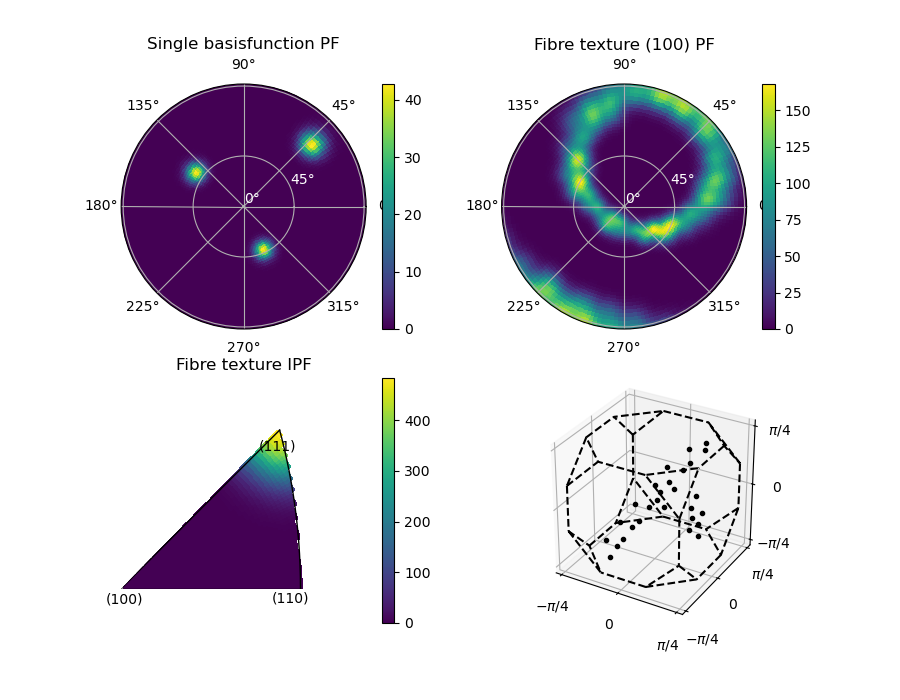
RBF expansion used to model a fibre texture. The non-zero expansion coefficients fall along a line in orientation space leading to an approximately rotationally symmetric pole figure.
Gaussians in SO(3) and S(2)
In both SO(3) and S(2) we have a conventional distance function, which we measure in radians. Radially symmetric functions can then be written as functions of one scalar variable of this distance, say \(\beta\).
The most obvious Gaussian function might be \(F(\beta) = N\exp(-\beta^2/(2\sigma^2))\), but this function is not smooth near the antipole, \(\beta = \pi\). Instead, we use the function: \(G(\beta) = N\exp(-(1-\cos\beta)/\sigma^2)\) (the von Mises Fisher Kernel in mtex). By inserting the Taylor expansion of the cosine-function, one sees that \(F\) approximates \(G\) for \(\beta << 1\) and because the function anyways goes rapidly to zero for \(\beta >> \sigma\), it becomes a good approximation (in an absolute sense) everywhere for \(\sigma << 1\). (In practice \(\sigma < 0.2\), see plot below.)
The value of this approximation is that we can derive an approximate shape of the pole-figure as a marginalization of a 3D Gaussian:
Which is simpler to work with than the exact result.
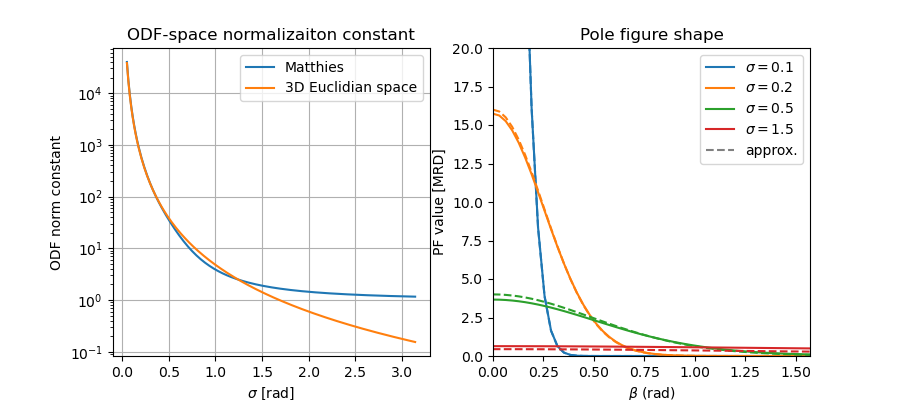
Normalization constant of normal gassian function versus the exact result and pole-figure kernel shape for various values of the \(\sigma\). Exact and approximate.
Jupyter notebooks: